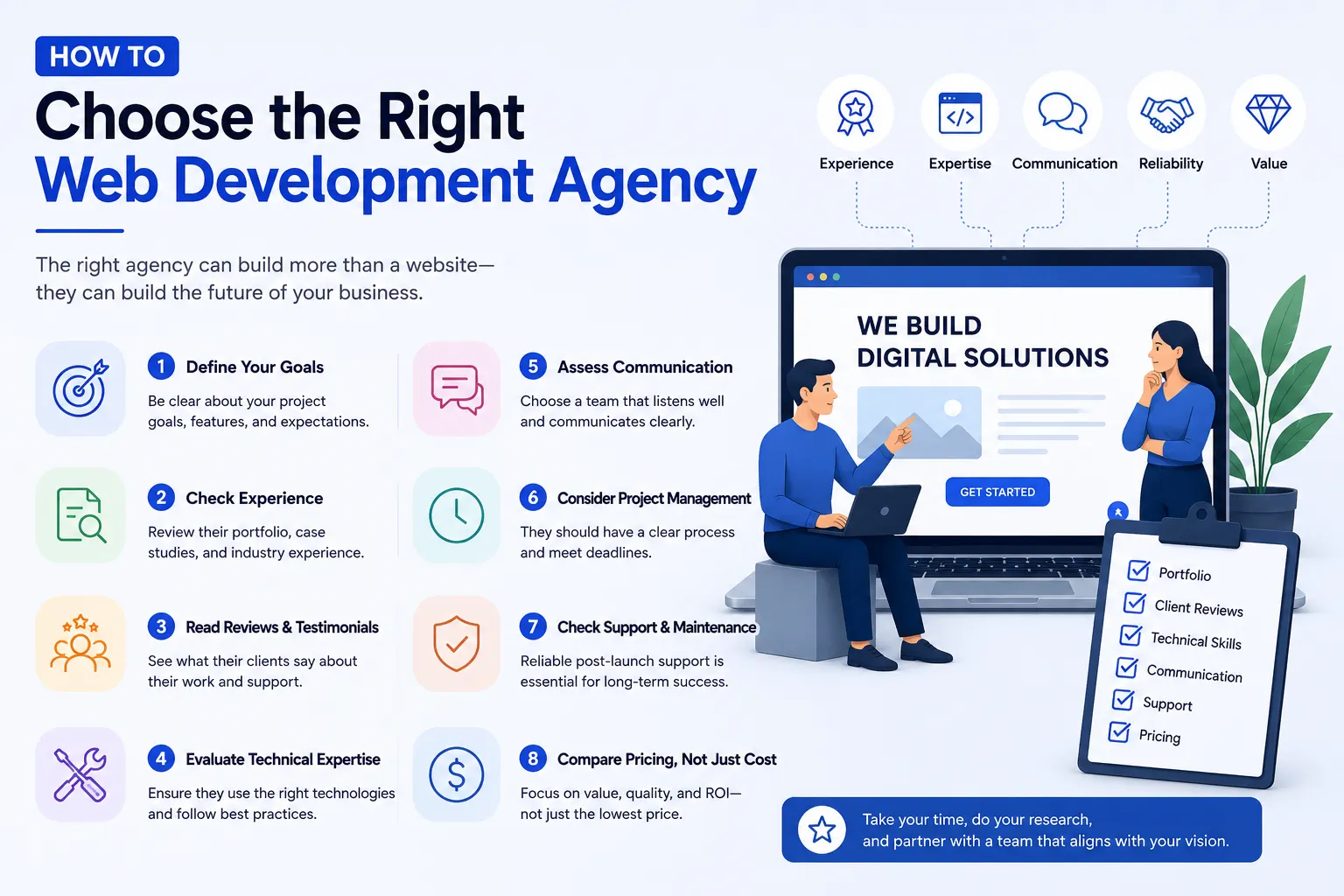
By a consultant who has sat on both sides of the table — hiring agencies and working inside them.
Most businesses get this wrong the first time. They pick a web development agency based on a slick portfolio and a confident sales call, sign a contract, and then spend six months chasing updates and fixing someone else’s decisions. I’ve watched it happen more times than I can count.
Choosing the right web development agency is one of the more consequential decisions a business makes. Your website isn’t just a digital brochure — it’s often where customers form their first real opinion of you. Get the agency wrong, and you’re not just wasting budget. You’re losing time you won’t get back.
Here’s what actually matters when making that call.
Know What You’re Actually Buying
Before you talk to a single agency, get clear on what you need. This sounds obvious. It isn’t.
There’s a real difference between:
- A brochure website — a few pages, decent design, no complex functionality
- An e-commerce platform — product catalogs, cart logic, payment gateways, and inventory
- A web application — user accounts, dashboards, real-time features, APIs
- A CMS-driven site — heavy on content, needs non-technical editors to update it
Agencies specialize. A studio that builds gorgeous marketing sites for lifestyle brands is unlikely to be a good fit for a healthcare portal with strict compliance requirements. The reverse is also true — a technically deep software agency might overbuild a three-page landing site and charge accordingly.
Write down what you actually need before the first conversation. It forces clarity and immediately filters out agencies that aren’t a fit.
Portfolio Tells You Less Than You Think
Everyone looks at portfolios. You should too — but don’t stop there.
A portfolio shows you what an agency has designed. It doesn’t tell you whether those projects launched on time, whether the client was happy, or whether the site actually performs. I’ve seen beautifully designed case studies for projects that were six months late and over budget.
What to ask instead:
- “Can I talk to a past client in a similar industry?”
- “What was the biggest challenge on this project and how did you handle it?”
- “What’s your typical process when requirements change mid-project?”
How an agency answers the last question tells you a lot. Requirements always change. How they handle that is the real measure of whether working with them is manageable.
The Tech Stack Question
You don’t need to be a developer to ask this question, but you do need to understand the answer.
A good web development agency will explain its recommended technology stack and why it suits your specific situation. WordPress, Webflow, Next.js, Laravel, Shopify — these aren’t interchangeable. The right choice depends on your scalability needs, your internal team’s ability to maintain the site, and your budget for ongoing development.
Red flags:
- An agency that defaults to the same stack for every client
- An agency that can’t explain the tradeoffs in plain language
- An agency pushing proprietary platforms that lock you in
That last one deserves extra attention. Some agencies build on proprietary CMS tools or custom frameworks that only they can maintain. That’s a dependency you may not want. Ask directly: “If we part ways tomorrow, can another developer pick this up?” The answer should be yes.
Read More: How Professional SEO Services Enhance User Experience and Website Performance
Communication Is Non-Negotiable
The number one complaint I hear from businesses that have had bad agency experiences? Communication. Not code quality, not design — communication.
Missed updates. Vague timelines. Emails answered three days late. Project managers who disappear after kickoff.
Before signing, ask:
- Who is my day-to-day point of contact?
- How often will I get project updates?
- What tools do you use for project management? (Asana, Jira, Notion — something tangible)
- What’s your average response time for client messages?
Then test it. Send an email before you sign the contract. See how long it takes to get a response. That response time during the sales process is usually faster than what you’ll get once the deal is closed.
Price vs. Cost — They’re Not the Same
Cheap agencies exist. Some are genuinely good. Many are not.
The agencies quoting 60% less than everyone else are often cutting corners somewhere — junior developers doing senior work, outsourcing to regions with lower rates without proper oversight, or simply underestimating the project scope and planning to upsell you later.
That said, expensive doesn’t mean excellent. Some large agencies carry enormous overhead, and you’re partly paying for their office space and account directors who add meetings but not output.
The question isn’t “who’s cheapest?” or “who’s most expensive?” It’s: what’s included, what’s not, and what happens when scope changes?
Get everything in writing. Fixed-price vs. hourly. Revision limits. Who owns the code? What’s the handover process? What post-launch support looks like.
A vague contract is a future argument waiting to happen.
Local vs. Remote — Does It Matter?
Sometimes yes, sometimes no.
If your project requires heavy collaboration — lots of feedback loops, design workshops, in-person stakeholder reviews — a local web development agency might genuinely be worth a premium.
For most standard projects? Location matters less than process. Some of the best agencies I’ve worked with operate fully remote. Some of the worst were down the street.
What matters is timezone overlap and meeting cadence. An agency six time zones away with clear async communication can outperform a local one that’s always “out of office.”
The Right Agency Pushes Back
Here’s something counterintuitive: the best agencies don’t just say yes.
If an agency agrees with everything you say in the pitch, that’s a warning sign. Good developers and designers have opinions. They’ll tell you your idea has a technical issue, or that a proposed feature will create a worse user experience, or that your timeline isn’t realistic.
You want a partner who brings expertise to the table — not one who nods along and bills the hours.
The best question to ask before hiring anyone: “Is there anything about this project that concerns you?” Their answer reveals whether they’ve actually thought about your problem or just want the contract.
Final Thought
There’s no perfect agency. There’s only the right one for your specific project, budget, and working style. Do the homework upfront — the portfolio review, the reference calls, the awkward questions about what happens when things go wrong.
The businesses that get this right treat agency selection like hiring a key employee. Because in a lot of ways, that’s exactly what it is.