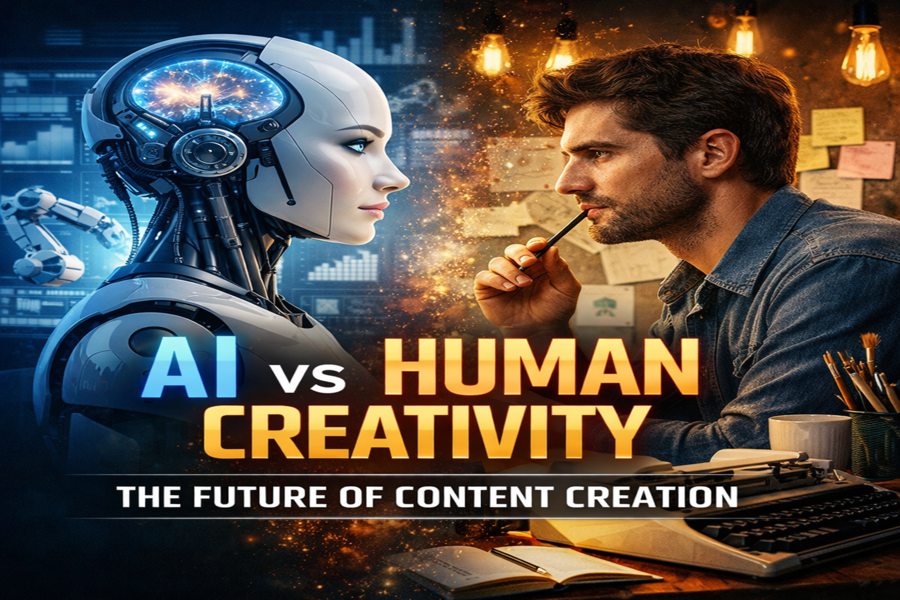
The process of how content is made has evolved fleetly in recent times. In the history, pens, contrivers and marketers. Only reckoned on mortal chops when making textbooks, announcements, vids and marketing systems. AI moment can induce blog content, design illustrations, and indeed suggest engaging captions. ( bones that sound good in the air) Kick around marketing strategies for metropolises or novels in seconds.
This shift has sparked an important debate — can AI replace mortal creativity? Or will humans and machines cooperate to determine the future of content creation?
So let’s explore what AI is, how it differs from mortal creativity, where they come together and a little of the unborn Content Creation.
What is AI in Content Creation?
The term Artificial Intelligence describes computers that can do things humans currently do. AI is used to process large quantities of data, analyze it, and create content using patterns and algorithms that they have learned.
Today, AI is used for:
Writing blog articles
Creating social media captions
Generating marketing ideas
Designing graphics and images
Video editing assistance
Keyword research and SEO optimization
AI tools are also enabling creators to generate content at a pace never before seen.
But speed is not the end-all, be-all of content creation. Creativity, emotion and storytelling remain a driving force.
What is Human Creativity?
Human creativity has an origin in emotions, feelings, imagination and thoughts of individuals. The things that matter most: culture, jokes, story lines and real life are so much more understandable for humans than for machines.
A human writer can:
Add emotions and personality
Understand audience feelings
Create unique storytelling angles
Share real experiences
Build trust through authenticity
For instance, when you hear a farmer tell their true story about using a tractor in daily work on the farm. It becomes more of an authentic narrative than data points.
This is the emotional connection where humans remain strong.
How AI is Changing Content Creation
The global Content value chain is now revolutionized by AI. Many companies today rely on AI to save time and lighten the workload.
Faster Content Production
Drafts can be created within seconds due to AI. Marketers are no longer building from scratch.
Better Data Analysis
AI researches search patterns, user behavior and keywords to recommend the best content topics.
Improved SEO Performance
Artificial intelligence AI helps writers develop content that meets the search engine needs.
Content Personalization
AI can suggest personal content based on the user’s preference and browsing history.
Due to these benefits, AI has become a powerful tool for content creators.
Strengths of AI in Content Creation
There are several practical advantages that AI offers which cannot be overlooked.
Works 24/7 without fatigue
Handles repetitive tasks easily
Generates ideas quickly
Helps beginners start writing
Supports multiple languages
Provides SEO suggestions
For companies with big websites, AI accelerates productivity and consistency.
But AI also has limitations.
Limitations of AI Creativity
AI may be faster and more efficient, but it lacks certain human qualities.
Lack of Emotion
AI does not feel emotions. It knows how to guess words from data, but it doesn’t really understand feelings.
Limited Original Thinking
AI produces content based on information already in existence. Real innovation usually originates from a person’s mind.
Context Challenges
AI can also sometimes fail to understand a cultural or social context, which could affect the quality of storytelling.
Over-Automation Risk
Too much AI-generated content can cause stories to sound robotic or redundant.
This is why human input remains indispensable.
Strengths of Human Creativity
Humans put depth and quirkiness into content.
Emotional Intelligence
We all know how to tell a joke, or empathize with someone, or share a story.
Unique Perspectives
Each person’s background is unique and thus informs the way they think about creativity.
Storytelling Ability
We tell stories that resonate on a personal level.
Ethical Judgment
Humans can judge the sensitivity, respect and propriety of content.
These are the strengths that human creativity possesses no substitute.
The Future: Collaboration Between AI and Humans
The future of content creation isn’t AI taking over for people. It is AI assisting humans.
AI can handle:
Research
Draft creation
Keyword suggestions
Data analysis
Humans can focus on:
Creativity
Storytelling
Strategy
Brand voice
Emotional connection
Combine them in concert, and content is transformative: it’s impactful, efficient and thrilling to consume.
How Content Creators Can Use AI Smartly
Below are practical methods that creators can use to integrate AI with human creativity:
Use AI for Research
AI tools can assist in generating ideas rapidly.
Edit Content Manually
Always fact-check and humanize AI content.
Add Personal Experience
Real examples make content trustworthy.
Maintain Brand Voice
Human editing ensures consistency.
Focus on Value
Write content that solves a problem for the reader.
Challenges in the Future of Content Creation
AI is awesome, but creators must be careful.
There can be a downside to too much automation.
Quality and authentic content can also be favored by search engines
Audiences prefer human storytelling
There will be increased concern with ethical use of AI
Those who best marry technology and artistry will flourish.
Why Human Touch Will Always Matter
People fall for stories, not algorithms.
A reader recalls emotions, experiences and stories that can be related back to. It creates trust and the audiences are in long-term relationships with the human creativity.
AI can help creativity but not supplant human imagination, empathy or passion.
Those who are most effective at being creators in the future will be those who use AI as a creative partner rather than a substitute.
Conclusion
Content creation is never going to be the same again with AI. It’s made writing faster, research quicker, marketing more intelligent. But creativity isn’t just the act of creating words; it’s emotion, thought, human experience.
Content creation of the future will belong to those able to meld AI efficiency with human creativity.
Instead of wondering if AI will replace humans, the question should be: How can humans and AI work together to produce better content?
It’s simple really – technology delivers power, but human beings give it meaning.